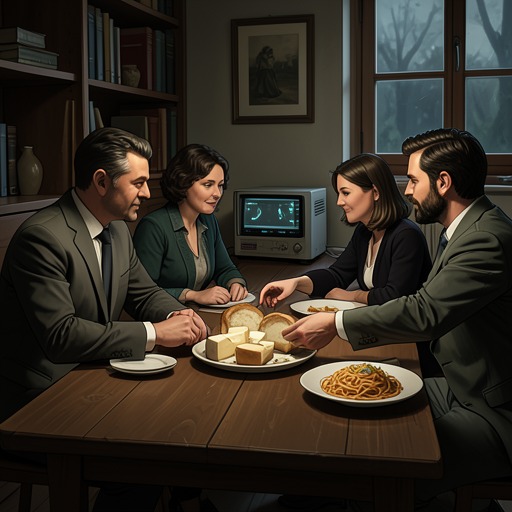
Ava and Gabriel's Napa Valley weekend trip
My Hot Secret: Geheimes Baby mit dem CEO Milliardär - Enemies to Lovers (German Edition)Ava and Gabriel’s Napa Valley weekend journey is the decisive interval in which guarded assessment becomes genuine attachment. Ava initially treats renewed contact with Gabriel as a controlled inquiry into whether he could be a good father while she conceals her pregnancy; by the journey’s end, the work-centered woman who had planned to disappear if he proved unsuitable admits that she wants him not only in the baby’s life but in her own. Gabriel, meanwhile, uses the trip to show that his devotion to pleasure can also take the form of attentive planning, patience, and care.
A Carefully Designed Escape
Gabriel plans the weekend as a sequence of impressions. He arranges for a helicopter to carry them from San Francisco to the Napa Valley shortly after sunrise, explicitly hoping to show Ava what he can offer and to deepen the connection that their earlier conversation about loss had revealed. Ava first assumes that they are traveling by car and accepts the passenger seat without protest; the helicopter is therefore both a practical surprise and a controlled break from ordinary urban movement.
The arrival establishes the trip’s contrast with Ava’s usual life. Fresh country air, early warmth, a waiting driver, and the view of the valley replace the city and the pressures of work. Gabriel’s itinerary is not improvised indulgence: it includes a stylish spa set into a hillside among tall trees, an old brick path edged with low thyme, massages, a facial treatment, and time in hot springs. The setting gives physical form to the rest and luxury that Ava has previously resisted allowing herself.
The journey also has an economic and ethical tension. Gabriel explains his willingness to pay for their experiences as a belief that money is pointless when it is merely hoarded and can instead make the present more pleasant. Ava finds the attitude difficult not to read as selfish because her employment is unstable while Gabriel owns a flourishing bakery, yet the weekend gradually supplies a different interpretation of his spending. His resources are not used only for display; they are converted into carefully observed experiences intended to make her comfortable and happy.
Spectacle, Care, and Shared Attention
Gabriel’s surprises progressively move Ava from skepticism toward participation. A large multicolored hot-air balloon appears as though it has come out of nowhere, and Ava is astonished that he arranged it for her. As the balloon rises through thermodynamics above the precisely planted vineyards, wineries spread across the valley floor and hills below them like a painting. The scale of the view matters because Ava does not merely observe the landscape as another attraction: she leans into Gabriel, touches him with her shoulder, and allows him to put an arm around her while they share the scene.
The trip’s visual design is therefore also relational. Gabriel acts as curator of Ava’s gaze, moving her through the spa, the vineyards, the balloon, and later the train, but the experiences become meaningful when her responses exceed the role of grateful spectator. She increasingly stops pushing him away. His hand on her back is accepted rather than rebuked, and the balloon ride turns a public spectacle into a private moment of mutual absorption.
Food provides another route into intimacy. Gabriel’s identity as a baker is already associated with Brioche, which he describes as light, fluffy, slightly sweet bread enriched with milk and eggs; during their baking date he explains that milk, butter, and eggs give the dough its richer flavor. These details make his pleasure concrete as skilled labor rather than abstract extravagance. Later, a simple pizza eaten beneath the oaks becomes the setting in which Ava confesses that she has not thought about work even once during the trip. The contrast between elaborate arrangements and ordinary shared eating shows that the weekend’s effect does not depend solely on luxury.
The Romantic and Emotional Turning Point
The final surprise is dinner aboard the Napa Valley Wine Train. Ava arrives after an exciting sexual encounter with Gabriel, feeling physically relaxed and emotionally elevated; every accidental touch and glance produces renewed excitement. At the station, the antique train’s red-and-gold carriages make her feel as though she has entered a film. Once moving, the train passes farms, vineyards, and old and modern farmhouses in the valley’s golden evening light, extending the weekend’s suspended atmosphere into a slow passage through a landscape unlike the city and the office.
That train ride clarifies the weekend’s central contradiction. Ava’s love of work and powerful urge to return to it stand against the happiness and exhilaration she experiences with Gabriel. She had told herself that she was merely investigating his paternal suitability, but the journey exposes the limits of that explanation. She now wants Gabriel as a person in her life, not only as a possible father for the child. The value shift is from observation to desire: she is no longer simply collecting evidence about him but acknowledging her own stake in the relationship.
Gabriel’s restraint is crucial to this change. Ava had feared that his carefree, pleasure-seeking manner signaled selfishness or an inability to commit. Instead, the weekend gives her evidence of patience and of a willingness not to pressure her. She does not interpret this as proof that he is ready for marriage, and she remains cautious about boundaries, but she can imagine that a man who respects her limits might also be capable of being present for a baby.
Consequences and Aftermath
The last day does not erase Ava’s professional ambitions. She wakes saddened that the trip is ending but refreshed and determined to revise the presentation she plans to give Trevor and John. The time away has restored her clarity: she intends to return to work, persuade them in the meeting, and then tell Gabriel about the baby. Having a definite sequence of actions makes the pregnancy feel less like an overwhelming burden and more like a decision she can carry out.
The journey also changes Gabriel’s relationship to responsibility. After learning the truth, he declares that he no longer wants to be the man who evades responsibility or teaches their child to run from problems. He resolves to regain control of HFI and transform it from a symbol of his father’s abandonment into something positive. Ava welcomes the decision partly because the company’s employees would lose their jobs if it failed. The weekend’s lesson in care thus expands beyond romance: the possibility of family prompts Gabriel to reconnect with an inheritance he had treated as a wound.
The trip’s legacy continues through recurring food and gesture. Later, while Ava is pregnant and eating a croissant with Gabriel in a park, she bites something hard and discovers a gleaming object hidden among the pastry’s loose layers. The concealed object converts the bakery’s language of nourishment and surprise into a proposal, linking the weekend’s curated pleasures to Gabriel’s eventual decision to make a lasting commitment. What began as Ava’s private test of whether Gabriel could be trusted ends by changing the terms of trust itself: she discovers that care can be accepted without surrendering independence, and Gabriel begins to understand responsibility as an active choice rather than a prison.